
1. A return missing the required facts can't support a default
Kassin v. 3909 Ponce de Leon, LLC, Third District Court of Appeal, No. 3D24-0199, opinion filed February 5, 2025. Read the opinion.
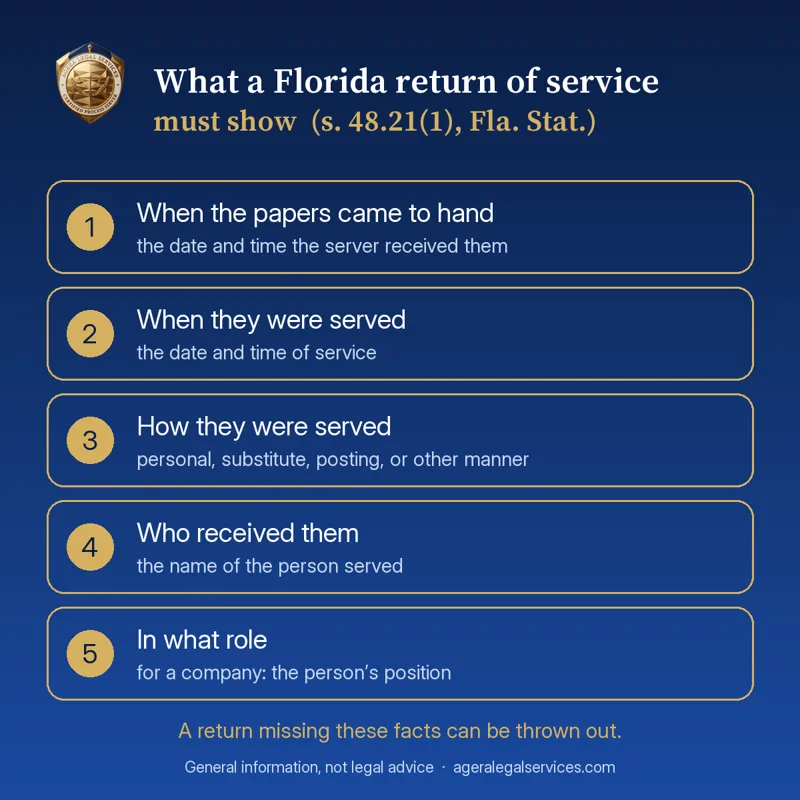
What happened. A default judgment was entered against a business and its managing member. On appeal, the Third District found two problems: the record held no process showing that the individual was served, and the business's return of service left out facts that section 48.21(1) requires.
What the court did. It called the omissions "fatal to the validity of service," reversed, and sent the case back with instructions to grant the motions to quash service and vacate the default. A return missing the statutory facts does not get the presumption of validity a complete return gets.
Why it matters for service. The return is the only thing the court sees of the serve. Read more in our guide to the affidavit of service and Florida process service questions.
2. Email service on defendants abroad: no "try everything else first" rule
Wepard Corp. v. Diaz, Reus & Targ, LLP, Third District Court of Appeal, No. 3D25-0252, opinion filed January 21, 2026. Read the opinion.
What happened. A Miami law firm sued companies located in Malta, and the trial court authorized service by email under section 48.197(1)(c). The defendants argued the firm first had to try Malta's Central Authority under the Hague Convention.
What the court did. It affirmed. Unlike the domestic statute, section 48.102, the foreign-service statute does not require a showing of due diligence before email service. The court listed three conditions: a court order, a method reasonably calculated to give actual notice, and no prohibition by international agreement. It also held that two defendants waived their challenge by first asking the court for sanctions and attorney's fees.
Why it matters for service. For defendants abroad, court-ordered email can come first. For defendants in the United States, section 48.102 still requires due diligence before another method is allowed. See how we serve papers from other states.
3. Registered agents and their employees (effective October 1, 2025)
CS/HB 157, chapter 2025-13, Laws of Florida, approved April 29, 2025. Official bill analysis and section 48.091.
- Longer office hours. A registered agent's office must now be open 2 p.m. to 4 p.m. on weekdays, in addition to 10 a.m. to noon.
- Serving an employee. If the registered agent is a person and is not at the office, the papers may be served on any employee of the agent present there, even on the first attempt.
- Serving the agent elsewhere. A registered agent who is a person may also be served like any individual, under section 48.031.
- Receiverships. A business in receivership is served through its receiver.
- Secretary of State. The law clarifies when substituted service through the Secretary of State may be used.
- Safe harbor. Service made under either the 2022 version of chapter 48 or the earlier law is validated, unless a court already ruled otherwise.
Why it matters for service. Serving a Florida company's registered agent is easier than it was. Look up the agent on Sunbiz, and read what to send your process server.
4. Service on series LLCs (effective July 1, 2026)
CS/SB 316, chapter 2025-162, Laws of Florida, approved June 20, 2025. Section 48.062 now covers registered foreign series limited liability companies and their protected series, LLCs formed in other states that hold separate "series" inside one company. The law treats some of them as nonresidents in certain situations and spells out how the summons and complaint are served on them.
Bottom line
- Every return of service should show all the facts section 48.21(1) lists.
- Serving a registered agent now has a 2 to 4 p.m. window and an employee rule.
- Defendants abroad can be served by court-ordered email in Florida.
More from us: the 120-day service deadline calculator, the eviction notice calculator and all our guides, tools and reports.